What is the difference between an electric generator and an engine?
Electric Generator vs Engine: What Is the Difference and How Do They Work Together?
If you have ever looked at a diesel generator set and wondered whether the engine and the generator are the same thing, you are not alone.
Many people use the terms "generator" and "engine" interchangeably. In reality, they are two completely different components that perform two completely different functions.
Understanding the difference between an engine and an electric generator is essential when selecting, operating, or maintaining power generation equipment.
In this article, we explain how these two components work together to produce electricity and why understanding their roles can help you make better purchasing and maintenance decisions.
What Is an Engine?
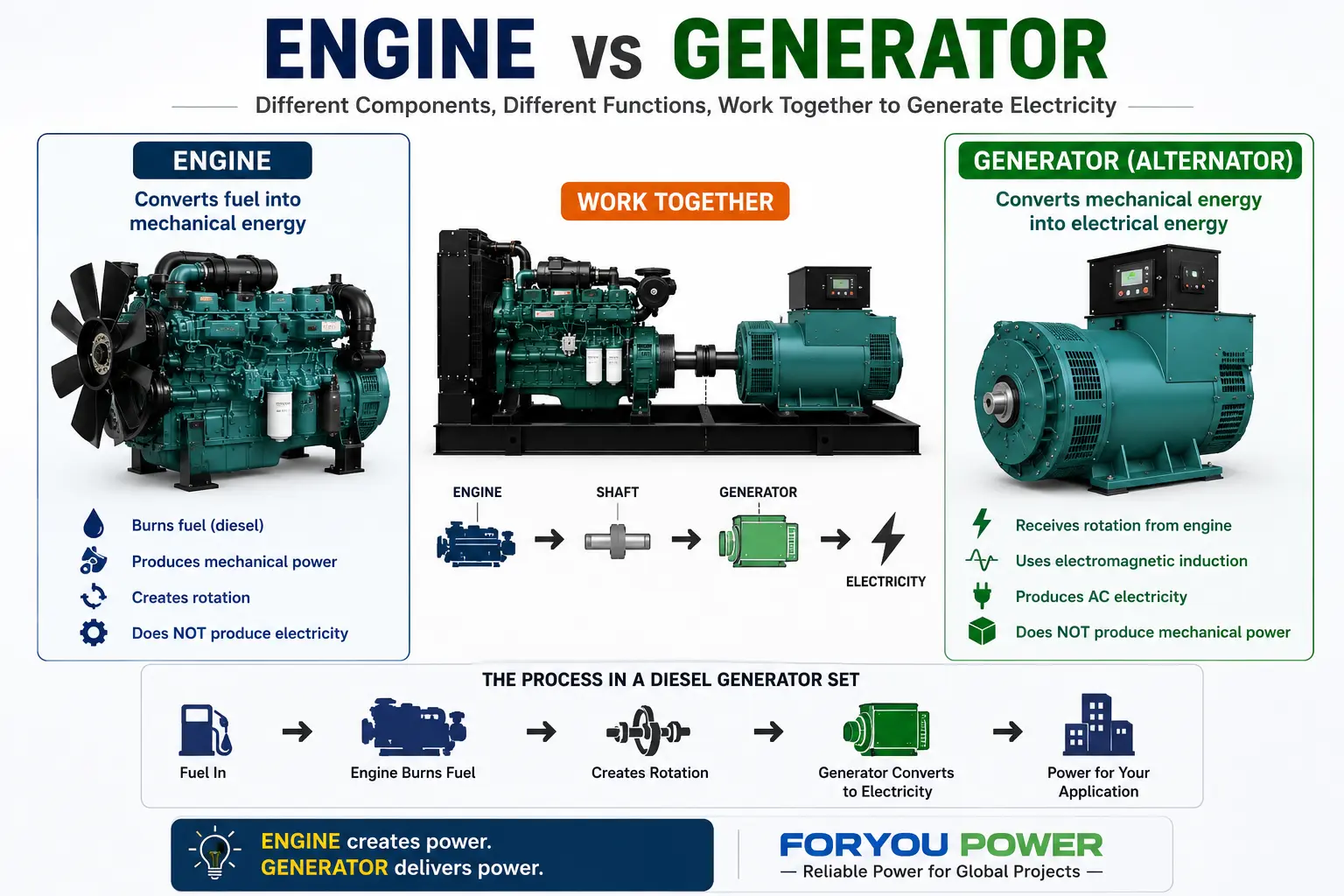
An engine is a machine that converts fuel into mechanical energy.
In a diesel generator set, the engine burns diesel fuel inside its cylinders. The combustion process creates force that moves pistons and turns the crankshaft.
This rotational movement becomes mechanical power.
The engine itself does not produce electricity.
Its only purpose is to create mechanical energy that can drive another machine.
Common engine brands used in industrial generator sets include:
-
Cummins
-
Perkins
-
Baudouin
-
MTU
-
Weichai
-
Ricardo
The engine serves as the primary power source of the generator set.
Without the engine, there would be no rotational force available to generate electricity.
What Is an Electric Generator?
An electric generator, often called an alternator, converts mechanical energy into electrical energy.
It operates based on the principle of electromagnetic induction.
When a conductor moves through a magnetic field, electrical current is produced.
Inside the alternator:
-
The rotor rotates
-
A magnetic field is created
-
Electrical current is induced in the stator windings
-
AC power is generated
Unlike the engine, the alternator does not burn fuel.
It contains no combustion system and cannot create motion by itself.
Instead, it relies entirely on mechanical input from the engine.
Without rotational force from the engine, the alternator cannot generate electricity.
Engine vs Generator: What Is the Main Difference?
| Engine | Electric Generator |
|---|---|
| Converts fuel into mechanical energy | Converts mechanical energy into electrical energy |
| Burns diesel, gas, or petrol | Uses electromagnetic induction |
| Produces rotation | Produces electricity |
| Requires fuel | Requires mechanical input |
| Power source | Power converter |
A simple way to remember the difference is:
The engine creates power.
The generator converts power into electricity.
Both components are equally important, but they perform completely different jobs.
How Do They Work Together in a Diesel Generator Set?
A diesel generator set combines these two components into a single integrated system.
The engine and alternator are mounted on the same base frame and connected through a coupling.
The process works as follows:
Step 1
The diesel engine starts and burns fuel.
Step 2
The crankshaft rotates and produces mechanical energy.
Step 3
Mechanical energy is transferred to the alternator through the coupling.
Step 4
The alternator converts rotational energy into electrical energy.
Step 5
Electricity is delivered to connected equipment, facilities, or critical systems.
This process happens continuously while the generator is running.
The result is a stable and reliable power supply for industrial, commercial, and emergency applications.
Why Understanding the Difference Matters
Many generator buyers focus only on the total power rating while overlooking the importance of individual components.
Understanding the difference between the engine and alternator helps when:
Selecting a Generator
Different engine brands offer different fuel efficiency, maintenance intervals, and operating characteristics.
Alternator quality affects:
-
Voltage stability
-
Frequency regulation
-
Power quality
-
Load handling capability
Troubleshooting Problems
Engine-related issues may include:
-
Starting failure
-
Excessive fuel consumption
-
Overheating
-
Smoke emissions
Alternator-related issues may include:
-
Voltage fluctuations
-
Low output voltage
-
Frequency instability
-
Winding failures
Identifying which component is causing the problem reduces downtime and repair costs.
Ordering Spare Parts
Many operators mistakenly order alternator parts when the problem originates from the engine, or vice versa.
Knowing the distinction helps avoid unnecessary expenses and speeds up maintenance activities.
Choosing a Reliable Diesel Generator
The performance of a generator set depends heavily on both the engine and the alternator.
A high-quality diesel generator should combine:
Reliable Engine
Examples:
-
Cummins
-
Perkins
-
Baudouin
-
MTU
High-Performance Alternator
Examples:
-
Stamford
-
Leroy Somer
-
Mecc Alte
The right combination ensures:
-
Stable voltage output
-
Low fuel consumption
-
Long service life
-
Excellent load acceptance
-
Reliable operation in demanding environments
Why Choose FORYOU POWER?
FORYOU POWER is a professional diesel generator manufacturer and exporter based in China.
We provide generator solutions ranging from 20kVA to 2500kVA for:
-
Construction Sites
-
Industrial Facilities
-
Mining Projects
-
Commercial Buildings
-
Hospitals
-
Data Centers
-
Emergency Backup Systems
Our generators are powered by world-class engines including Cummins, Perkins, Baudouin, MTU, and Weichai, paired with premium alternators to ensure maximum reliability and performance.
Every generator undergoes comprehensive testing before shipment to guarantee dependable operation in real-world conditions.
Frequently Asked Questions
Is an Engine the Same as a Generator?
No.
An engine creates mechanical energy by burning fuel, while a generator converts that mechanical energy into electricity.
Can a Generator Work Without an Engine?
No.
An alternator requires an external mechanical power source to rotate and generate electricity.
In most generator sets, that power source is a diesel engine.
Which Component Produces Electricity?
The alternator produces electricity.
The engine only provides the mechanical force needed to drive the alternator.
Conclusion
Although the terms are often confused, an engine and an electric generator perform entirely different functions.
The engine generates mechanical power through fuel combustion, while the alternator converts that mechanical power into usable electrical energy.
Together, they form the heart of every diesel generator set.
Understanding this relationship helps operators make better purchasing decisions, diagnose problems more accurately, and maintain equipment more effectively.
If you are looking for reliable diesel generators for industrial, commercial, or construction applications, FORYOU POWER offers a complete range of solutions tailored to your project requirements.
Need Help Selecting the Right Generator?
📧 info@foryougen.com
FORYOU POWER – Reliable Power for Global Projects.
Water-Cooled vs Air-Cooled Diesel Generators: Which Is Better for Industrial Applications?